
News & Insights / An innovative coffee idea. A bank that said no.
An innovative coffee idea. A bank that said no.
Platō’s Stephan Bredell had an idea, a plan, and a funding gap. This is the story of what changed when CCS asked the right questions.
- June 25, 2026
- by Mesh
Watch Stephan’s story in full
Stephan Bredell sat across from Willie Mouton with an idea and an info sheet. Not a business plan. Not a set of financials. A single page describing a really innovative idea: speciality coffee served in a converted shipping container, in a model no bank in South Africa was willing to finance. Willie read it. He evaluated the entrepreneur. And he said yes.
Stephan had already started and closed a few businesses. He was carrying debt. His family had invested in ventures that hadn’t worked out. So the bank was not an option. There was, as he describes it, nowhere left to turn.
“ I was quite in debt. I couldn’t get money from the bank. Family resources were also tapped out. That’s where CCS came in. If it wasn’t for that connection, Platō maybe wouldn’t be here today. ”
Stephan Bredell • Founder • Plato Coffee
What CCS offered was not a standard business loan. Willie structured a 36-month rent-to-own arrangement covering the container and the equipment, everything required to open and operate the first Platō store. A complete funding solution for a concept that had no balance sheet, no trading history, and no collateral beyond the assets that CCS was financing. The assets and Stephan’s conviction about the business.
The first eight Platō stores were funded entirely this way. Each one bootstrapped through the same model: CCS providing the asset-backed finance, the store opening, the store proving itself, and the relationship deepening.
“ Willie bought into the broader vision of the first store, and then they saw it worked, and then they backed us. The first eight shops were all CCS-funded. Because it was so heavily asset-financed, it was a safe play in a way. ”
Stephan Bredell • Founder • Plato Coffee
Those eight stores did more than prove the concept. They created the visible, replicable evidence that made the franchise model possible. A single Platō location is an interesting coffee shop. Eight operational Platō locations are a franchise proposition. When prospective franchisees could walk into eight working stores and see the system functioning, the question changed from ‘will this work?’ to ‘how do I get one?’
CCS also evolved alongside the business. As the brand grew and the model proved itself, the funding expanded to cover fully built-out retail shops, not just container conversions, with all the elements a mature franchise location required. The relationship between Platō and CCS moved from emergency funding for a first-time founder to a structured growth partnership.
“ If it wasn’t for them, we wouldn’t have been able to scale to 8 shops and then go from 8 to 140 with franchising. They played a pivotal part in the whole Platō story. ”
Stephan Bredell • Founder • Plato Coffee
What CCS funded, and how they decided
CCS provided asset-backed equipment finance for the containers and the coffee machines each new Platō location required. The assessment process was direct.
“ There’s no financial institution out there that will finance a shipping container, let alone one converted into a coffee shop. But we did our assessment. We saw these guys could still afford to run this coffee shop with their monthly salaries. We first look at the repayment ability, then we look at the asset. ”
Willie Mouton • CEO • Investment Platform
Repayment ability first. Asset value second. Not balance sheet history, but the practical question of whether the cash flow can service the deal and what happens to the asset if it cannot.
For investors, these are the mechanics behind the income. Every machine CCS finances generates a monthly rental from the day it starts operating. That rental income flows back through the platform. Part of it funds the monthly coupon that CCS Income Note holders receive.
The CCS relationship
“ I think it was how the banks used to be, where you talk with a human and the guy understands what you’re trying to do. It’s very pragmatic. Very relational. You’re not talking to some bot. You’re meeting, really, for coffee, and you explain the process. That is, for me, the easiest way to access funding. ”
Stephan Bredell • Founder • Plato Coffee
That description recurs across every client in this portfolio, expressed differently but pointing to the same thing: CCS’s value is not only structural. It is operational. Founders who understand their businesses need a lender who takes the time to understand them too.
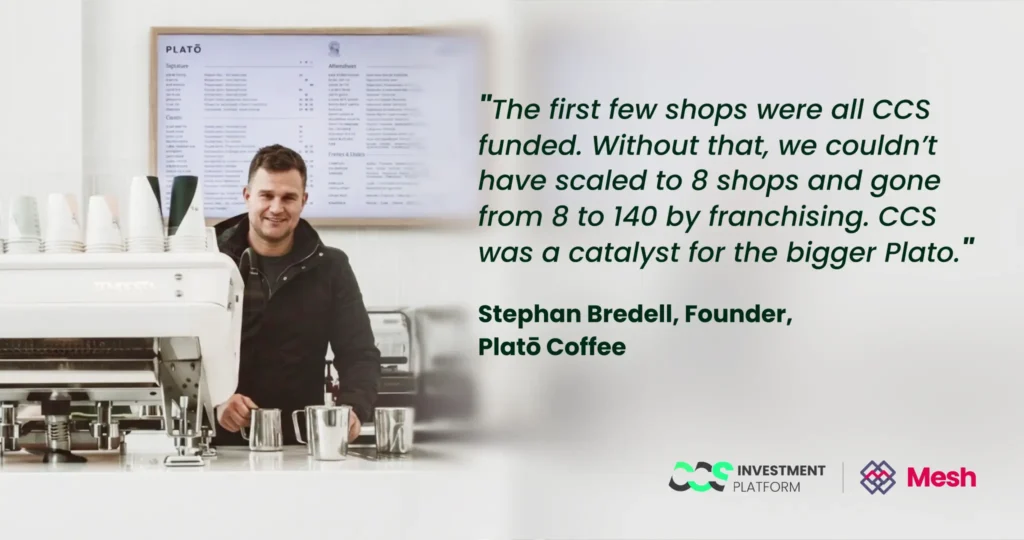
“ The shops were all CCS-funded. Without that, we couldn’t have scaled to eight corporate shops and gone from eight to 140 with franchising. CCS was a catalyst for the bigger Platō. ”
Stephan Bredell • Founder • Plato Coffee
Over 140 locations. The beginnings of an international footprint. Around 700 barista jobs. Ninety franchisees.
“ We’re feeding about 5,000 people a month if you think about it. If you told me six years ago we’d have 140 shops, I would have said never. ”
Stephan Bredell • Founder • Plato Coffee
The model is still working. The CCS Income Notes give investors structured access to the same type of income stream: contractual rental payments from businesses using productive assets to generate income.
The CCS Income Notes are live on Mesh.trade.
Prime + 3% per annum | Monthly income payments | Invest from R5,000
This post is for informational purposes only and does not constitute investment advice.
Tags
Alternative investments AltFi Asset-Backed Finance Bankruptcy-remote Blockchain Capital Markets Capital Markets of the Future CCS Investment Platform Commodity Markets Crypto Markets DeFi Equipment Finance Financial Markets Fully backed stablecoin Global Markets Investing Investment Liquidity management Mesh Mesh Mint mZAR Open to all Regulation Secondary Market Smart Assets SME Finance Stablecoin transparency Tokenisation Tokenised cash Yield-bearing stablecoin yZAR
- Alternative investments, Asset-Backed Finance, Business Funding, CCS Investment Platform, Entrepreneur Success Stories, Equipment Finance, Franchise Growth, Growth Capital, Mesh, Plato Coffee, Private Credit, SME Finance, SME Lending, South African SMEs
Want to stay in the know on upcoming events and seminars?
Newsletter Sign Up
For more press information, please contact:
Connie Bloem, Product owner of Mesh:
hello@meshtrade.co / +1 604 671 4515