
News & Insights / Copper isn’t Gold. That’s the point
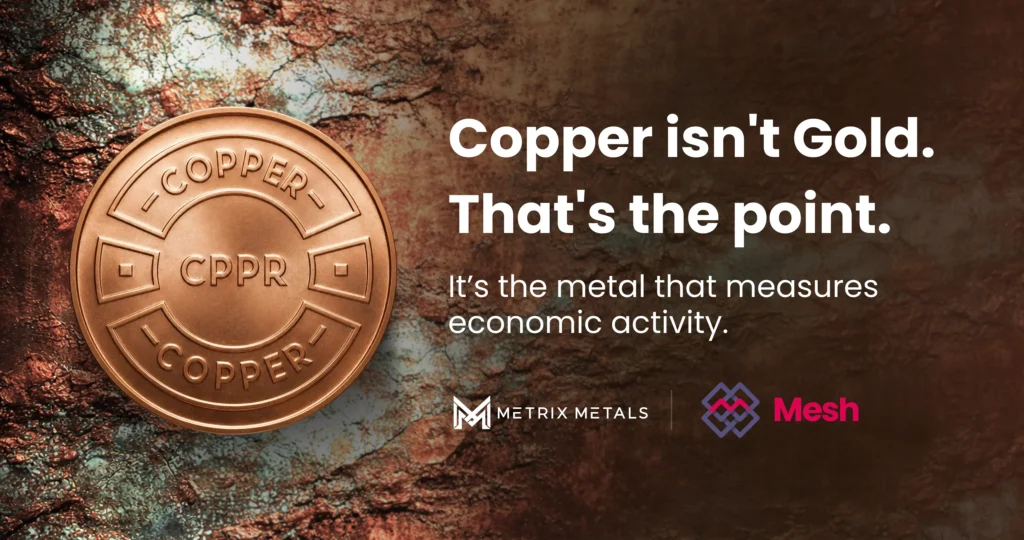
Copper isn’t Gold. That’s the point
Gold stores value. Copper measures economic activity. Discover why copper offers a different type of exposure to infrastructure, electrification and growth.
- June 10, 2026
- by Mesh
Cu, Soon
Before a single kilowatt reaches a socket, before an EV moves a metre, before a data centre processes a query, copper has already done its work. It is the metal that makes the modern world run. And it has never been more in demand.
Copper is not a monetary metal. Where gold stores value, copper measures activity. Its price reflects whether factories are expanding, grids are being upgraded, and infrastructure is being built, in developed and developing economies alike. Not financial sentiment. Real output.
That distinction matters for investors.
The Diagnostic Metal
Investors and analysts have tracked copper for decades because its price is directly sensitive to what is actually happening in the economy. When copper demand rises meaningfully, it’s because factories are expanding, grids are being upgraded, and infrastructure capital is being deployed at scale.
The commodity has earned the nickname Dr Copper precisely because it functions as a diagnostic instrument for economic health, not sentiment, not monetary policy, not geopolitical risk, but visible industrial activity.
An electric vehicle uses three to four times more copper than its petrol equivalent. Every kilometre of transmission infrastructure requires copper conductors. A single offshore wind turbine requires approximately three to four tonnes of copper. AI data centres, and the cooling and power distribution systems they require, are an exponential copper consumer. These are not forecasts. They are specifications.
What Makes Copper Different
Copper does not ask questions. It measures output by providing actual industrial development, as opposed to store-of- value precious metals, such as gold or silver.
Where precious metals hold value in abstraction, copper reflects capital intensity. The scale of copper demand is a direct proxy for how much physical infrastructure is actually being built, not announced, not planned, but constructed and commissioned.
Lithium gets the battery narrative. Gold gets the monetary narrative. Rare earths attract geopolitical attention. Copper in the meantime, is carrying the weight of the entire energy transition at scale, quietly, structurally, and in measurable tonnes.
The Access Problem, Until Now
Most South African investors who wanted copper exposure accessed it through JSE-listed mining equities. That approach bundles commodity exposure with everything else a mining company carries: operational risk, labour relations, management execution, input cost volatility, and political noise. None of those variables are related to the price of copper.
The rand itself has historically carried copper correlation, which means South African investors already hold structural copper exposure whether they intend to or not. The question is whether that exposure is intentional and efficiently expressed, or accidental and diluted.
CPPR is the clean version. One token. One tonne of LME 999 A-Grade Copper. Physically stored. Institutionally governed. Priced in rand.
Own the metal. Not the company.
CPPR is a financial asset issued by Metrix Metals (Pty) Ltd on Mesh.trade. Prospective investors should review the Investor Memorandum and obtain independent financial advice.
Tags
Alternative investments AltFi Asset-Backed Finance Bankruptcy-remote Blockchain Capital Markets Capital Markets of the Future CCS Investment Platform Commodity Markets Crypto Markets DeFi Equipment Finance Financial Markets Fully backed stablecoin Global Markets Investing Investment Liquidity management Mesh Mesh Mint mZAR Open to all Regulation Secondary Market Smart Assets SME Finance Stablecoin transparency Tokenisation Tokenised cash Yield-bearing stablecoin yZAR
- AI infrastructure, Alternative investments, Blockchain, Capital Markets, Commodities, Commodity investing, Copper (CPPR), Copper investment, Electrification, Energy transition, Industrial Metals, LME-linked pricing, Mesh, Physically backed assets, Real asset investing
Want to stay in the know on upcoming events and seminars?
Newsletter Sign Up
For more press information, please contact:
Connie Bloem, Product owner of Mesh:
hello@meshtrade.co / +1 604 671 4515